
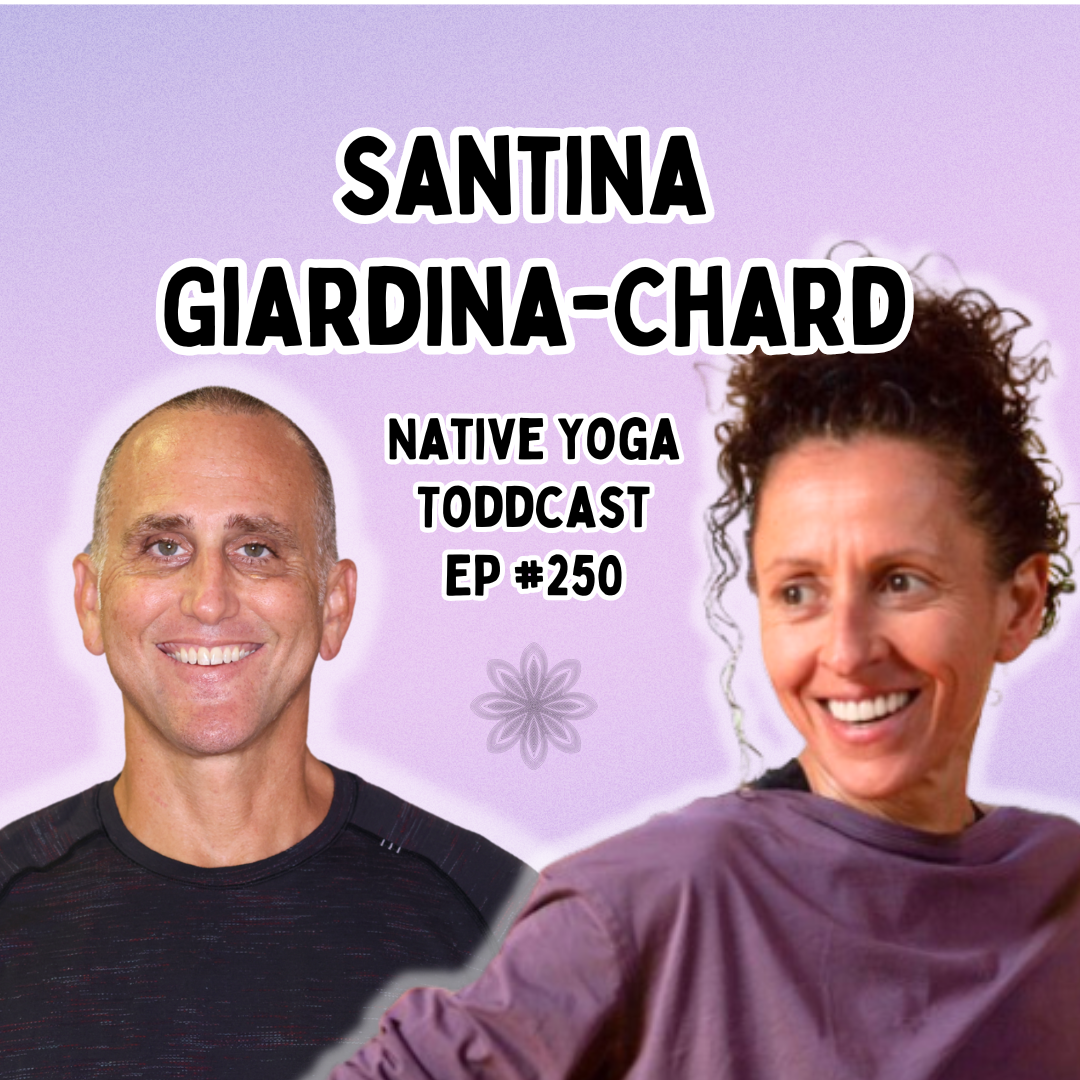
Listen to Toddcast with Santina for FREE here
Santina Giardina-Chard is a dedicated Ashtanga yoga teacher, having mastered all levels up to the fourth series. Alongside her yoga practice, Santina is a certified gestalt therapist with a master’s degree, tirelessly working with clients to explore how their past influences their present experiences and relationships. Her holistic approach combines yoga and gestalt therapy to offer profound insights into personal development and self-awareness.
Visit Santina here: https://insanyoga.com/
Key Takeaways:
- Integration of Yoga and Therapy: Santina illustrates how Ashtanga yoga and gestalt therapy synergize to promote self-awareness and personal growth.
- Freedom Through Deep Self-Contact: The practice of turning towards personal challenges and emotions with curiosity can lead to liberation from past patterns.
- Phenomenological Observation: Understanding one’s physical and emotional reactions in the present moment is essential for overcoming past influences.
- Horizontal Relationship Dynamics: Gestalt therapy emphasizes creating a non-hierarchical, safe space for exploration and healing.
- Continual Learning in Practice: Both yoga and gestalt therapy require ongoing personal development to effectively support others.
The Intersection of Ashtanga Yoga and Gestalt Therapy: A Path to Self-Discovery
Santina Giardina-Chard, an accomplished Ashtanga yoga teacher and Gestalt therapist, offers a unique perspective on the integration of these disciplines, fostering a transformative journey of self-discovery and healing. Throughout her conversation with Todd, she shares her evolution from a struggling addict to a liberated practitioner who embraces the complexity of human experience.
Drawing from her own story, Santina delves into the synergy between yoga and therapy. While Ashtanga yoga helped “clean up” her life by providing a structured, disciplined practice, it was Gestalt Therapy that enabled her to truly understand her inner world. “Ashtanga,” she expresses, “is a laboratory. Everything’s happening there. It’s all coming to the surface.”
Her narrative highlights the importance of not merely practicing yoga for physical postures but for what they reveal about the self. She notes, “People think they’re coming for postures, but it’s not. They want contact… something new arises in me that I didn’t know about myself.”
Santina explores the role of the therapist and yoga teacher as facilitators who create a safe, non-hierarchical space for individuals to face themselves. She emphasizes the Gestalt concept of engaging in field dialogue, stating, “I notice your eyes, I notice your lips… and that’s what happens in the Mysore Room. I say something, and the organism, not the posture, is being impacted.”
Paradox of Change: Embracing Authenticity and Presence
Central to Santina’s approach is the paradoxical theory of change found in Gestalt Therapy. She explains, “We don’t change by trying to change. We change by allowing ourselves to be as we are.” This concept underscores the importance of authenticity and presence, countering the pervasive drive for self-improvement through forceful change.
Santina recounts her personal struggles with addiction and eating disorders. Her turning point came upon realizing that seeking external change often led to deeper internal conflicts. Instead, accepting and observing her present state allowed for organic transformation. “I’m close with myself,” she reflects, “I’m wondering what it is for you to get marutchyasana D… I want you to check out really what it means to you.”
This approach transforms both psychotherapy and yoga into practices of deep listening and inquiry, where one’s internal and external realities are acknowledged and respected. Her insight resonates with Krishnamurti’s teachings on freedom and self-awareness, highlighting the necessity of turning towards emotions rather than fleeing from them. “In that moment,” Santina shares, “the resistance towards myself drops.”
Emotional Anatomy: Organizing the Inner Landscape
Santina introduces the conceptual framework of “emotional anatomy,” wherein the body’s organization reflects accumulated life experiences. This theme is crucial in understanding how one’s past informs present behaviors and reactions, often subconsciously. She articulates, “The student in front of you is an organization of how they’ve experienced their life.”
Her work focuses on unveiling this organization, allowing individuals to observe their interruptions and choose how to respond. She notes, “Shame is still there… but that’s from the past. It’s not now.” By facing these interruptions authentically, one reclaims the power to shape their narrative and regain agency over their life.
Santina’s perspective resonates through the transcript, illustrating how individual growth emerges from this acknowledgment and acceptance of one’s “unfinished business.” Through Gestalt Therapy, she provides tools for addressing these lingering influences. Her philosophy creates an empowering framework for students and clients alike.
Embracing Freedom through Self-Understanding
Engaging with her unique blend of Ashtanga yoga and Gestalt Therapy, Santina Giardina-Chard unveils a path toward genuine self-understanding and freedom. Her commitment to fostering an environment of safety, inquiry, and acceptance underscores the importance of exploring one’s internal landscape. Rejecting the urge to change externally without understanding internally, she embraces the process of becoming through gentle, patient inquiry.
Santina’s narrative demonstrates that true freedom lies not in achieving complex postures or attaining an idealized state, but in understanding and meeting oneself with compassion and curiosity. As she powerfully concludes, “You want to be free now. You can’t be free if you’re always in the same unfinished business… look deeply, you want to be free.”
Through Santina’s insights and teachings, we can appreciate the profound transformative power inherent in merging physical practice with psychological exploration. This work illuminates a path to healing that harmoniously integrates body, mind, and soul, providing a beacon of hope for those seeking a deeper connection with their authentic selves.
Thanks for listening to this episode. Check out: 👇
8IN8 Ashtanga Yoga for Beginners Course Online– Learn 8 Limb Yoga in 8 Days – Get FREE coupon code for a limited time only (Regular price $88) https://info.nativeyogacenter.com/8in8-ashtanga-yoga-for-beginners-8-limbs-in-8-days/
Practice with Native Yoga Online – New classes EVERY day – Use Code FIRSTMONTHFREE https://nativeyogacenter.teachable.com/p/today-s-community-class
Subscribe to Native Yoga Center and view this podcast on Youtube.
Thank you Bryce Allyn for the show tunes. Check out Bryce’s website: bryceallynband.comand sign up on his newsletter to stay in touch. Listen here to his original music from his bands Boxelder, B-Liminal and Bryce Allyn Band on Spotify.
Please email special requests and feedback to info@nativeyogacenter.com
https://info.nativeyogacenter.com/8in8-ashtanga-yoga-for-beginners-8-limbs-in-8-days/
Native Yoga website: here
YouTube: here
Instagram: @nativeyoga
Twitter: @nativeyoga
Facebook: @nativeyogacenter
LinkedIn: Todd McLaughlin
 Native Yoga Blog