
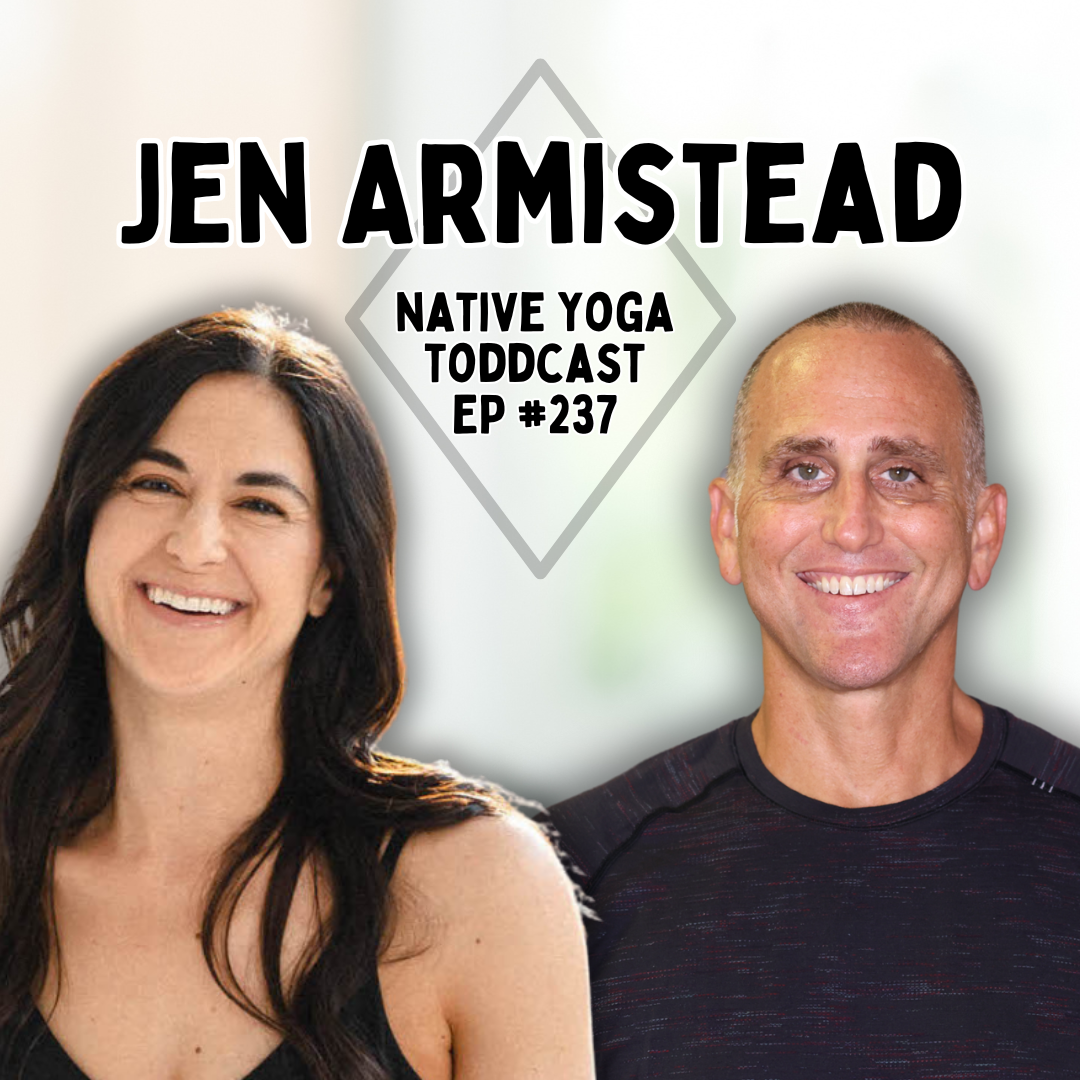
Listen to Toddcast with Jen for FREE here
Jen Armistead is an accomplished scientist turned yoga teacher and studio owner. With a Ph.D. in molecular microbiology and immunology and a background in public health, Jen dedicated two decades to researching and implementing strategies to combat malaria, particularly among vulnerable populations in Africa. She now co-owns Yoga Commons, a yoga studio in Fairfax, Virginia, where she shares her passion for Ashtanga, Rocket, and Dharma Yoga practices, drawing inspiration from notable teachers like Dharma Mittra and David Kyle.
Visit Jen here: https://www.yoga-commons.com/ and on IG here: https://www.instagram.com/yogaendeavour/?hl=en
Key Takeaways:
- Jen Armistead’s journey exemplifies a unique transition from scientific research in malaria to becoming a dedicated yoga teacher and studio owner.
- Her experience in Africa exposed her to the realities of global health challenges and the importance of implementing effective disease-fighting strategies.
- Jen finds inspiration in yoga legends like Dharma Mittra, striving to integrate deep spiritual teachings within her yoga community.
- She navigates the challenges of maintaining an authentic yoga studio while facing commercial pressures, emphasizing the importance of flexibility and community.
- Jen’s story highlights the significance of adaptive career pivots and the potential for personal growth during unexpected life changes.
Yoga and Science: A Harmonious Coexistence
In the bustling intersection of yoga and science, Jen Armistead stands as a testament to the possibility of merging these seemingly disparate fields. With her Ph.D. in molecular microbiology and immunology, and a long-standing dedication to public health, Jen has spent decades working on malaria prevention in Africa. She describes herself as “one of those rare people who kind of knew where they were headed from a pretty young age,” demonstrating her steadfast dedication to science.
Despite the common perception that science and spirituality are mutually exclusive, Jen’s journey reveals a different narrative. She articulates, “It’s a depressing way to live your life to think that we’re born and we die and that’s the end of it. For me, I just don’t accept that,” asserting her belief in spiritual dimensions parallel to her scientific pursuits. This marriage of the pragmatic and the profound underscores not only Jen’s personal growth but also the potential for a broader societal acceptance of such integration. Her journey reflects a nuance that is often overlooked in the socio-cultural dialogue between religion, spirituality, and science.
From Laboratories to Yoga Studios: Embracing Change
Jen’s transition from a scientific career to owning a yoga studio marks an inspiring narrative of resilience and adaptability. After a restructuring at USAID led to the dismantling of her division, she leveraged her skills and passion for yoga to navigate her career transition. This unexpected change paved the way for the birth of Yoga Commons in Fairfax, Virginia. As Jen humorously conveys, “I’m an accidental entrepreneur.”
Creating a community-oriented studio wasn’t part of Jen’s original plan; yet, when faced with a unique opportunity, she embraced it. Building a supportive atmosphere centered around authentic yoga traditions such as Ashtanga, Rocket, and particularly Dharma Yoga, Jen is preserving and disseminating diverse practices. The studio embodies a vision where authenticity triumphs over commercial trends. “We needed to find a different space… because that gym couldn’t accommodate us,” she notes, emphasizing the commitment to maintaining traditional yoga roots.
Authenticity in Yoga Entrepreneurship
In a world of heated, fast-paced, commercially-driven yoga, Jen’s approach to her studio is refreshingly authentic. She champions a non-commercialized model, placing community and spirituality above profit. The studio emphasizes genuine connections and spiritual growth—a rarity in the current yoga industry. Jen elaborates, “You need to know the rules before you can break them,” a principle she applies by teaching structured Ashtanga alongside the more fluid Rocket Yoga to encourage flexibility within discipline.
Investing in Dharma Yoga further highlights Jen’s dedication to authenticity. Dharma Mittra’s lineage offers a deeply spiritual practice, and Jen articulates, “It was less about this is the physical practice. It was more about like, I want that.” Her respect and passion for these time-honored traditions offer her students a richer, more comprehensive yoga experience.
The narrative of Jen Armistead serves as a powerful reminder that life’s unpredicted changes can lead to remarkable outcomes when met with the right mindset. Her experience embodies the seamless interplay of science and spirituality, offering a blueprint for those at similar intersections.
Moreover, Jen’s entrepreneurial journey underscores the importance of authenticity in the face of commercial pressures, insisting on yoga as a way of life rather than mere physical exercise. Her story invites us to consider what it truly means to lead with integrity and purpose in our professional and personal lives, challenging us to find balance, embrace change, and uphold authenticity.
Thanks for listening to this episode. Check out: 👇
8IN8 Ashtanga Yoga for Beginners Course Online– Learn 8 Limb Yoga in 8 Days – Get FREE coupon code for a limited time only (Regular price $88) https://info.nativeyogacenter.com/8in8-ashtanga-yoga-for-beginners-8-limbs-in-8-days/
Practice with Native Yoga Online – New classes EVERY day – Use Code FIRSTMONTHFREE https://nativeyogacenter.teachable.com/p/today-s-community-class
Subscribe to Native Yoga Center and view this podcast on Youtube.
Thank you Bryce Allyn for the show tunes. Check out Bryce’s website: bryceallynband.comand sign up on his newsletter to stay in touch. Listen here to his original music from his bands Boxelder, B-Liminal and Bryce Allyn Band on Spotify.
Please email special requests and feedback to info@nativeyogacenter.com
https://info.nativeyogacenter.com/8in8-ashtanga-yoga-for-beginners-8-limbs-in-8-days/
Native Yoga website: here
YouTube: here
Instagram: @nativeyoga
Twitter: @nativeyoga
Facebook: @nativeyogacenter
LinkedIn: Todd McLaughlin




 Native Yoga Blog