Andrew Eppler: Uncovering the Mysteries of Mysore and the True Roots of Ashtanga Yoga

Listen to Toddcast with Andrew for FREE here

Andrew Eppler is a renowned yoga practitioner and documentarian with a deep-rooted connection to Ashtanga yoga. Having begun his yoga journey at the age of 14 under the guidance of his father, Andrew quickly became engrossed in the world of Mysore-style Ashtanga, which has profoundly shaped his life. Known for his insightful documentary “Mysore Yoga Traditions,” Andrew has worked tirelessly to document and highlight the roots and evolution of yoga practices. He is also the driving force behind the Mysore Yoga conference, which invites practitioners to dive deeper into the cultural and practical aspects of yoga.

Visit Andrew here: https://www.mysoreyogatraditions.com/

Key Takeaways:

  • Andrew Eppler’s yoga journey began at a young age, significantly influenced by his father’s connections and the transformative practice of Ashtanga yoga.
  • The development and creation of Ashtanga yoga involve a rich tapestry of cultural, historical, and personal influences, with significant contributions from Indian royalty and yoga masters.
  • Andrew’s documentary, “Mysore Yoga Traditions,” seeks to uncover the mythical and historical roots of Ashtanga yoga, blending modern practice with ancient traditions.
  • Engaging with Sanskrit and understanding its numerical and musical intricacies is crucial in truly grasping the depths of yoga philosophy.

Exploring Mysore’s Rich Heritage: A Culmination of History and Modernity

The interview with Andrew Eppler reveals a world where tradition and modernity intertwine, shedding light on the rich heritage of Mysore Yoga traditions. Eppler’s journey, beginning at age 14 under the influence of an Ashtanga practitioner visiting Oklahoma, ultimately led him to Mysore, the cornerstone of his exploration into yoga’s roots. This personal connection and subsequent pilgrimage highlight the allure and enigma of Yoga’s spiritual homeland.

Eppler recounts how the Mysore Yoga Traditions documentary began with an intention to document his teacher BNS Iyengar’s teachings, but it evolved into an exploration of a broader community. “When this guy crosses over, it would be a shame not to document all these teachings that he has,” remarks Eppler. Initially hesitant, Iyengar eventually contributed to the project in a broader context, showing the complexity of capturing such an authentic tapestry of history and cultural depth.

Preserving Mysore’s Ancient Knowledge: Challenges and Responsibilities

The preservation of historical manuscripts emerges as a crucial theme in Eppler’s narrative, particularly the elusive Yoga Korunta. The mystery of such ancient texts is underscored by the meticulous care required to maintain them against the ravages of time. “They will sometimes let you hold them in your hands. They’re delicate,” Eppler shares, conveying the tangible connection to a rich, yet fragile, cultural inheritance.

Eppler’s encounters with the principal of the Maharaja’s Sanskrit College opened a treasure trove of information, exemplifying the serendipity often experienced in India. This chance meeting led to unprecedented access. “We hit the jackpot,” he exclaims, underscoring the importance of seizing such unforeseen opportunities. The role of yoga practitioners worldwide in supporting these preservation efforts is gently urged, suggesting a collective responsibility towards these ancient teachings.

The Evolution of Ashtanga Yoga: From Personalized Practice to Global Movement

A deeply insightful segment of Eppler’s conversation reflects on the evolution of Yoga practice. He acknowledges the visionary work of Pattabhi Jois, credited with structuring Ashtanga Yoga’s primary series, while retaining respect for its roots. “Krishnamacharya taught Vinyasa flow… a precise drill designed to create impressive practitioners,” he notes, highlighting the discipline’s journey through time and its adaptation to contemporary needs.

Eppler also addresses the broader cultural influences that shaped modern yoga. He notes the contributions of Mysore’s royal family and King Krishnaraja Wadiyar, whose vision enabled Krishnamacharya’s teachings to flourish. This historical context reveals the adaptability of Yoga – an ancient practice now accommodating the modern seeker on a pragmatic path to self-discovery, while maintaining respect for tradition.

Harmonizing Tradition and Innovation in Yoga’s Dynamic Journey

Eppler’s vivid recounting of his experiences in Mysore emphasizes the dynamic interplay between tradition and innovation. His dedication to preserving the authenticity of teaching while acknowledging necessary adaptations presents a balanced view, highlighting how practitioners today can remain true to core values while embracing evolution.

The forthcoming documentary, “Kings and Yogis,” promises to delve deeper into the rich history shared by Mysore’s kings and Yogis, illuminating a tapestry that demonstrates the seamless integration of heritage and novelty. “The tradition of yoga in Mysore is old. It’s beautiful and very rich,” Eppler affirms, inviting a broader understanding of how these ancient teachings continue to inform and inspire modern practice.

In conclusion, Andrew Eppler’s insights serve as a compelling reminder of the profound legacy of Mysore Yoga traditions. Aspiring Yogis and seasoned practitioners alike are encouraged to explore this intricate history – a reminder of the enduring power of yoga as both an ancient spiritual practice and a continually evolving modern discipline.

Thanks for listening to this episode. Check out: 👇
8IN8 Ashtanga Yoga for Beginners Course Online– Learn 8 Limb Yoga in 8 Days – Get FREE coupon code for a limited time only (Regular price $88) https://info.nativeyogacenter.com/8in8-ashtanga-yoga-for-beginners-8-limbs-in-8-days/

Practice with Native Yoga Online – New classes EVERY day – Use Code FIRSTMONTHFREE https://nativeyogacenter.teachable.com/p/today-s-community-class

Subscribe to Native Yoga Center and view this podcast on Youtube.

Thank you Bryce Allyn for the show tunes. Check out Bryce’s website: bryceallynband.comand sign up on his newsletter to stay in touch. Listen here to his original music from his bands Boxelder, B-Liminal and Bryce Allyn Band on Spotify.

Please email special requests and feedback to info@nativeyogacenter.com

Support the show

Native Yoga website: here
YouTube: here
Instagram: @nativeyoga 
Twitter: @nativeyoga 
Facebook: @nativeyogacenter 
LinkedIn: Todd McLaughlin

Mariane Pinto ~ In the Mystic Flow

Mariane Pinto, a yoga teacher and Thai massage therapist, discusses her journey in the world of yoga and massage therapy. She shares how she discovered her passion for yoga and Thai massage, and how she incorporates both practices into her teaching and retreats. Mariane emphasizes the importance of finding a connection with your teachers and clients, and the power of non-psychedelic modalities in healing. Mariane’s upcoming retreats in Puerto Escondido, Mexico and Brazil are highlighted as transformative experiences for participants.

Visit Mariane on her website: https://www.themysticflow.com/
Follow Mariane on IG: @mari.in.the.flow https://www.instagram.com/mari.in.the.flow/
and on @the.mystic.flow https://www.instagram.com/the.mystic.flow/

Key Takeaways:

  • Mariane found her passion for yoga and Thai massage after going through a divorce and immersing herself in yoga practice.
  • She emphasizes the importance of finding a connection with your teachers and the yoga community.
  • Mariane offers unique experiences in her retreats, including surfing, sound healing, and breathwork.
  • She believes in the power of non-psychedelic modalities, such as meditation and yoga, to enhance the psychedelic experience.
  • Mariane encourages yoga teachers and massage therapists to find their niche and share their craft every day.

Native Yoga Toddcast: A Journey of Healing and Transformation

Welcome to Native Yoga Toddcast. In this episode, Todd McLaughlin sits down with Mariane Pinto, a yoga teacher, Thai massage therapist, and retreat leader. They discuss Mariane’s journey of self-discovery, her passion for yoga and Thai massage, and her upcoming retreats in Mexico and Guatemala. Join us as we delve into the world of healing and transformation.

Introduction: Embracing Your Dharma

In this episode of Native Yoga Toddcast, Todd McLaughlin welcomes Mariane Pinto, a yoga teacher, Thai massage therapist, and retreat leader. Mariane shares her excitement about fulfilling her dharma and finding her true calling in life. She reflects on her journey from practicing yoga as a means of healing after a divorce to becoming a traveling yoga teacher and Thai massage therapist. Mariane’s passion for yoga and Thai massage shines through as she discusses her upcoming retreats and the transformative power of these practices.

Exploring Yoga and Thai Massage

When asked about her journey into yoga and Thai massage, Mariane explains that yoga came first. She discovered yoga in her mid-20s during a difficult time in her life and found solace and healing through the practice. She eventually became a yoga teacher, studying under her mentor Kelly Doorly and specializing in Prana Vinyasa, a style developed by Shiva Rea. Mariane’s love for yoga led her to explore Thai massage as a way to deepen her understanding of the body and enhance her teaching skills. She embarked on a Thai massage course in Costa Rica and fell in love with the practice. Mariane describes Thai massage as a gentle and intuitive approach that combines stretching, breathwork, and relaxation. She emphasizes the importance of communication and listening to the receiver’s needs during a session.

The Power of Retreats and Sound Healing

Mariane’s passion for yoga and Thai massage extends beyond the studio. She leads retreats around the world, offering participants a transformative experience in beautiful locations. Mariane believes that retreats provide an opportunity for deep healing and self-discovery. She incorporates various modalities into her retreats, including sound healing, yoga nidra, and breathwork. Mariane explains that these practices help participants connect with their bodies, release tension, and find inner peace. She also emphasizes the importance of non-psychedelic modalities, such as meditation and yoga, in conjunction with psychedelic experiences. Mariane believes that these practices can help individuals access higher states of consciousness and facilitate personal growth.

The Challenges and Rewards of Teaching

As a yoga teacher and Thai massage therapist, Mariane faces various challenges and rewards. She acknowledges that marketing and promoting her services can be daunting, but she encourages aspiring teachers to find their niche and connect with their ideal clients. Mariane emphasizes the importance of authenticity and genuine connection in building a client base. She advises teachers to share their craft consistently, whether through social media, word of mouth, or collaborations with like-minded individuals. Mariane also highlights the importance of self-belief and resilience in the face of challenges. She encourages teachers to trust the process and have faith in their abilities.

The Future of Healing and Transformation

In conclusion, Mariane reflects on the future of healing and transformation. She believes that we all have the power to walk each other home, supporting and inspiring one another on our individual journeys. Mariane encourages individuals to show up for their own healing and embrace new experiences. She emphasizes the importance of being true to oneself and finding alignment with one’s purpose. Mariane’s retreats and teachings serve as a testament to the transformative power of yoga and Thai massage. As she continues to expand her offerings and explore new destinations, Mariane remains committed to creating meaningful experiences for her clients and helping them discover their own paths of healing and transformation.

In this thought leadership article, we have explored Mariane Pinto’s journey of healing and transformation through yoga and Thai massage. Mariane’s passion for these practices shines through as she shares her experiences and insights. We have delved into the power of retreats, sound healing, and non-psychedelic modalities in facilitating personal growth. Mariane’s advice on marketing and teaching provides valuable guidance for aspiring yoga teachers and Thai massage therapists. As we look to the future, Mariane’s commitment to authenticity and connection serves as an inspiration for all those seeking their own paths of healing and transformation.

Thanks for listening to this episode. Check out: 👇
Free Grow Your Yoga Live Webinar – Every Thursday at 12pm EST
➡️ Click here to receive link

New Student FREE Livestream Yoga Special ~ Try 2 Weeks of Free Unlimited Livestream Yoga Classes  at Native Yoga Center. info.nativeyogacenter.com/livestream Sign into the classes you would like to take and you will receive an email 30 minutes prior to join on Zoom. The class is recorded and uploaded to nativeyogaonline.com  ➡️  Click Here to Join. 

Practice to a New Yoga Class every day with our nativeyogaonline.com course called Today’s Community Class with code FIRSTMONTHFREE.

Native Yoga Teacher Training 2024– In Studio and Livestream – for info delivered to your email click this link here: ➡️ https://info.nativeyogacenter.com/native-yoga-teacher-training-2023/

Subscribe to Native Yoga Center and view this podcast on Youtube.

Thank you Bryce Allyn for the show tunes. Check out Bryce’s website: bryceallynband.comand sign up on his newsletter to stay in touch. Listen here to his original music from his bands Boxelder, B-Liminal and Bryce Allyn Band on Spotify.

Please email special requests and feedback to info@nativeyogacenter.com

Support the show

Native Yoga website: here
YouTube: here
Instagram: @nativeyoga 
Twitter: @nativeyoga 
Facebook: @nativeyogacenter 
LinkedIn: Todd McLaughlin
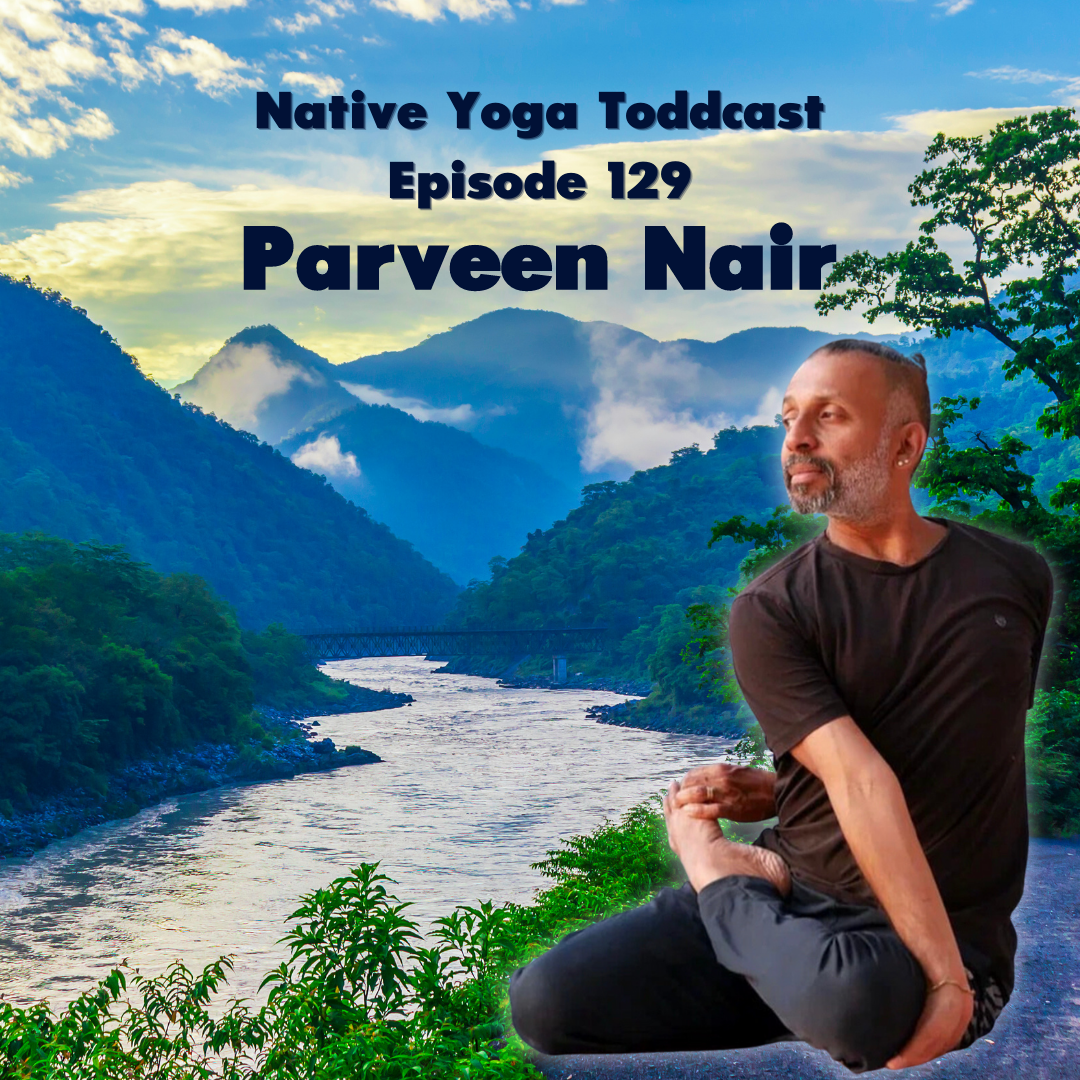
Parveen Nair ~ Embodiment: The Dance of Movement and Breath

Parveen Nair is a long-term yoga teacher and practitioner based in Rishikesh, India. He offers teacher trainings and programs in Rishikesh and is known for his creative and inspired yoga practice routines that incorporate pranayama and asana. Parveen’s approach to yoga is influenced by his background in dance and his deep spiritual connection to the practice.

Connect with Parveen on Instagram @inbornmovements https://www.instagram.com/inbornmovements/?hl=en
​
During this conversation Parveen speaks about:

  • Yoga is not about perfecting asanas, but about developing the capacity to bring quietness to the mind and recognizing one’s true nature.
  • The practice of centering and connecting with the body as it is, without trying to change or perfect it, is essential in yoga.
  • Deep sleep can serve as a reminder of one’s true nature and the peace that exists beyond the mind and body.
  • Templates can be helpful in guiding movement and creating an embodied yoga practice, but it is important not to copy or compare oneself to others.

Native Yoga Toddcast: A Journey of Yoga and Self-Discovery

Welcome to Native Yoga Toddcast, where we explore the world of yoga, meditation, and self-discovery. In this episode, we have the pleasure of speaking with Parveen Nair, a long-term yoga teacher and practitioner based in Rishikesh, India. Parveen shares his unique journey of finding yoga, his experiences with different styles of practice, and his evolving approach to teaching. Join us as we delve into the themes of centering, embodiment, and the true purpose of yoga.

Centering: Meeting Yourself as You Are

Parveen’s journey into yoga began in his childhood, growing up in a spiritually inclined family in Malaysia. He was introduced to the practice of kirtan, or devotional singing, which created a sense of peace and quietness in his mind. This early experience of connecting with the divine set the foundation for his later exploration of yoga.

“When we finish the practice towards the end, just like shavasana during shavasana after shavasana, there was this deep quietness. That made me curious. There was something in this quietness that felt like home.”

Parveen recognized the importance of meeting oneself as they are, without judgment or the need to change. He developed a practice of centering, where he invites his students to observe their bodies, breath, and thoughts without trying to fix or perfect anything.

“I started introducing in my classes the practice of arriving, centering. Observing where the body is at that time, how is it breathing, how is the mind thinking. Can you meet your body as it is, in acceptance of who and what you are?”

Embodiment: The Dance of Movement and Breath

Parveen’s background in dance and his training in Iyengar yoga influenced his approach to movement and asana practice. He recognized the importance of incorporating the breath and allowing the body to move in a soft and gentle manner.

“I found that the breath plays a very important role because then everything becomes very hard and tight. Any asana or any movement you’re doing, do it only if you can do it 100%. But do it only 50% and let the breath take you another 50%.”

Parveen created movement templates that allow the entire body to respond and awaken, while also giving space for individual exploration and creativity. He emphasizes the importance of not copying his movements, but rather finding one’s own unique expression within the practice.

“The medium is movement, but how do we use this movement to arrive at who you are potentially at that day? And to use that as a pathway to your peace.”

The True Purpose of Yoga: Discovering Your True Nature

Parveen challenges the notion that the purpose of yoga is to perfect the asanas or achieve physical goals. He believes that the true purpose of yoga is to develop the capacity to bring quietness to the mind and recognize one’s true nature.

“Perfection in Warrior One is not the purpose. How do you interact with Warrior One becomes spiritual, not perfecting. How do you perfect something which is constantly going through modification?”

He encourages students to shift their focus from external achievements to internal exploration, from identifying with the body and mind to recognizing the underlying canvas of awareness that supports all experiences.

“You are complete. Nothing added to you or subtracted from you is going to bring any peace because you are already peace. The purpose of yoga is to develop the capacity to bring some amount of quietness to your mind so that you can see what is your true potential, your natural potential.”

Conclusion: A Journey of Self-Discovery

Parveen’s journey of yoga and self-discovery is a testament to the transformative power of the practice. Through his experiences with different styles of yoga and his own inner exploration, he has come to understand the essence of yoga as a path to recognizing one’s true nature.

As students, we are invited to meet ourselves as we are, to embrace the body and mind with acceptance and curiosity. Through embodiment and movement, we can tap into the vastness of our being and experience moments of deep peace and connection.

The true purpose of yoga is not to achieve external goals or perfect the asanas, but to develop the capacity to quiet the mind and recognize our inherent completeness. It is a journey of self-discovery, where we uncover the truth of who we are beyond the limitations of the body and mind.

As we continue on our own yoga journeys, let us remember that the practice is not about reaching a destination, but about embracing the ever-unfolding process of self-discovery and awakening. May we find inspiration in Parveen’s teachings and continue to explore the depths of our own being.

Join us next time on Native Yoga Toddcast as we continue to bring you insightful conversations with inspirational speakers in the field of yoga, meditation, and beyond. Remember to follow us on Instagram @nativeyoga and visit our website at nativeyogacenter.com for more information. Until then, may you find peace and joy on your own yoga journey.

Thanks for listening to this episode. Check out: 👇
Free Grow Your Yoga Live Webinar â€“ Every Thursday at 12pm EST
➡️ Click here to receive link

New Student FREE Livestream Yoga Special ~ Try 2 Weeks of Free Unlimited Livestream Yoga Classes  at Native Yoga Center. info.nativeyogacenter.com/livestream Sign into the classes you would like to take and you will receive an email 30 minutes prior to join on Zoom. The class is recorded and uploaded to nativeyogaonline.com  ➡️  Click Here to Join. 

Practice to a New Yoga Class every day with our nativeyogaonline.com course called Today’s Community Class with code FIRSTMONTHFREE.

Native Yoga Teacher Training 2024– In Studio and Livestream – for info delivered to your email click this link here: ➡️ https://info.nativeyogacenter.com/native-yoga-teacher-training-2023/

Subscribe to Native Yoga Center and view this podcast on Youtube.

Thank you Bryce Allyn for the show tunes. Check out Bryce’s website: bryceallynband.comand sign up on his newsletter to stay in touch. Listen here to his original music from his bands Boxelder, B-Liminal and Bryce Allyn Band on Spotify.

Please email special requests and feedback to info@nativeyogacenter.com

Susy Markoe Schieffelin – Sound Healing for a Better You

Join my special guest Susy Markoe Schieffelin for a discussion on sound baths and the healing effects they inspire. Hear Susy talk about her journey to self discovery and how she is helping others join globally in sharing positive sound vibrations.

Visit Susy on her website: https://thecoppervessel.com

Instagram: @thecoppervessel https://www.instagram.com/thecoppervessel/

Instagram: @thesoundhealersacademy https://www.instagram.com/thesoundhealersacademy/

Youtube:  @TheCopperVessel 

  • What led Susy to sound healing?
  • Her thoughts on hair loss.
  • The light that comes from within.
  • How the different bowls are associated with the chakras.
  • How to start a sound bath.
  • Dealing with emotional reactions during a sound bath.
  • Shifting the focus to developing your personal experience.
  • The difference between a sound bath and a concert.

Susy Markoe Schieffelin of The Copper Vessel is a Los Angeles-based sound healer, reiki master, Kundalini yoga teacher, and inspirational speaker who has led sound baths viewed or attended by millions of people all over the world. Susy has brought healing to employees at companies such as Google, Pandora, and Nordstrom, has played crystal bowls with notable artists including Leann Rimes and the Los Angeles Philharmonic, and has been featured in publications such as WSJ, VOGUE, USA TODAY, and Los Angeles Times. Susy is known for her light-filled presence and ability to guide people towards radiant and empowered lives characterized by self-love, serenity, abundance, and joy. She is the founder of the Sound Healer’s Academy, an innovative Crystal Alchemy Sound Healing and Spiritual Business Mentorship training, serves as a self-love advocate for brands, has created custom product lines, and offers deeply restorative crystal alchemy sound bath ceremonies and healing rituals both in person and online. Learn more and follow Susy on Instagram @thecoppervessel.

You can listen to the full episode for free here: https://nativeyogacenter.buzzsprout.com

Free Grow Your Yoga Live Webinar â€“ Every Thursday at 12pm EST
➡️ Click here to receive link


Native Yoga Teacher Training â€“ In Studio and Livestream – for info delivered to your email click this link here: https://info.nativeyogacenter.com/native-yoga-teacher-training-2023/

https://info.nativeyogacenter.com/native-yoga-teacher-training-2023/

New Student Livestream Special ~ Try 2 Weeks of Free Unlimited Livestream Yoga Classes  at Native Yoga Center. Sign into the classes you would like to take and you will receive an email 30 minutes prior to join on Zoom. The class is recorded and uploaded to nativeyogaonline.com ~ Click Here to join.

Native Yoga website: nativeyogacenter.com
Online Yoga Class Library: nativeyogaonline.com
Thai Massage info: palmbeachthaimassage.com
Native Yoga Blog: toddasanayoga.com
Instagram: @nativeyoga
YouTube channel: Native Yoga Center

Listen to the podcast here on our Podcast website: Native Yoga Toddcast

Please email special requests and feedback to info@nativeyogacenter.com

Eric Shaw – Light On Yoga History and Philosophy

Ever wonder if there is more to yoga than just the yoga postures? Join my guest Eric Shaw for a discussion around his new book called Sacred Thread: A Comprehensive Yoga Timeline: 2000 Events that Shaped Yoga History.  Eric’s teachings and passions have been influenced significantly by his teachers, in particular Shandor Remete and Rod Stryker. You can visit Eric on his website at prasanayoga.com and you can purchase a copy of Eric’s new book on Amazon here.

We discuss topics like:

  • What is the pre-common era?
  • Yoga sutras and urbanization in India.
  • Buddha gives us a new philosophy of life.
  • The difference between consumer consumerism and environmentalism in India.
  • Mapping connections through language patterns.
  • Who were the key cultural movers of the Theosophical Society?
  • The History of the Hatha Yoga Project.
  • Historical perspective of Krishnamacharya’s story.

You can listen to the full episode for free here: https://nativeyogacenter.buzzsprout.com

Thanks for reading this blog post from this YouTube video. Check out: 

Free Grow Your Yoga Live Webinar â€“ Every Thursday at 12pm EST
➡️ Click here to receive link


Native Yoga Teacher Training â€“ In Studio and Livestream – for info delivered to your email click this link here: https://info.nativeyogacenter.com/native-yoga-teacher-training-2023/

https://info.nativeyogacenter.com/native-yoga-teacher-training-2023/

New Student Livestream Special ~ Try 2 Weeks of Free Unlimited Livestream Yoga Classes  at Native Yoga Center. Sign into the classes you would like to take and you will receive an email 30 minutes prior to join on Zoom. The class is recorded and uploaded to nativeyogaonline.com ~ Click Here to join.

New Student FREE 30 Minute Yoga Meet & Greet ~ Are you new to Native Yoga Center and have questions that you would like us to address? Whether you are coming to In Studio, Livestream or Online Recorded Classes we offer a one time complimentary 30 minute zoom meeting to answer any questions you may have. Schedule a time that is convenient for you. Click Here

Native Yoga website: nativeyogacenter.com
Online Yoga Class Library: nativeyogaonline.com
Thai Massage info: palmbeachthaimassage.com
Native Yoga Blog: toddasanayoga.com
Instagram: @nativeyoga
YouTube channel: Native Yoga Center

Listen to the podcast here on our Podcast website: Native Yoga Toddcast

Please email special requests and feedback to info@nativeyogacenter.com

Jeremy Strickland – Jin Shin Jyutsu in Rishikesh

Check out this discussion with Jeremy Strickland titled Jin Shin Jyutsu in Rishikesh. Jeremy practices and teaches Yin Yoga and Jin Shin Jyutsu bodywork in Rishikesh, India. Enjoy stories from the heartland of yoga as Jeremy speaks about the power and efficacy of Jin Shin Jyutsu therapy.

During this conversation Jeremy speaks about:

  • How he decided to live in Rishikesh?
  • Cranial sacral therapy and massage.
  • The convergence of traditional Chinese medicine and astrology.
  • Feeling the pulse of the heart.
  • Living in the yoga capital of the world.
  • The wildest thing he’s seen in India.

Jeremy’s bio:
Jeremy Strickland is a yoga instructor with a 500 hr RYT certificate from World Peace Yoga School, Rishikesh, India. He brings a light-hearted approach to asana practice, lifting spirits and making the complicated simple. His background is over 20 years as a Certified Massage Therapist in the USA, with a focus on Craniosacral Therapy and the esoteric art of Jin Shin Jyutsu physio-philosophy.

Visit Jeremy on his website: https://www.yinyoga1.com

Todd Mclaughlin

Well, welcome to Native Yoga Toddcast. I’m so happy that you are here. Today I have the pleasure of introducing you to Jeremy Strickland. Jeremy is a Jin Shin Jyutsu practitioner, which is a form of manual therapy utilizing contact points or points of awareness of the pulse in the body. And he is also a yin yoga instructor. He resides in Rishikesh, India, originally from USA, he has a website, check them out at yinyoga1.com. And you can also find him on the IG the Instagram with the handle @yinyoga_jinshinjyutsu. And of course, those links are in the description. Wherever you’re listening, just give a little click and I’ll take you right over. So happy to have this chance to introduce you to people that are experts in the field of yoga, and bodywork from all over the world. Remember that if you would like to practice with us here at native yoga center, in the description and links below, there’s a link for you to join to try two weeks of unlimited live stream yoga with us for free, you can join us for the classes that we offer to the public on a daily basis. And also every Thursday on YouTube Live, I do a free webinar where you can ask questions and so I have a different topic each week. And you can join in and ask questions via the chat box. So there’s a link there as well. You can click on that, check it out. And remember to go look for Jeremy on his website. yinyoga1.com. I hope you enjoy this discussion. Enjoy some cool stories from the other side of the world. Alright, let’s begin. I’m super excited to have the chance to speak with Jeremy Strickland. He’s a Jin Shin Jyutsu practitioner, also a yin yoga instructor. And he’s joining me today from Rishikesh, India. Jeremy, how are you doing today?

Jeremy Strickland

I am fabulous. It’s really exciting to be here.

Todd Mclaughlin

Oh, thanks, man. I’m really excited to have a chance to talk with you. First of all, I’m really curious, how did you land in Rishikesh India and managed to not leave?

Jeremy Strickland

Well, all by happenstance, just before India, I was actually living in Vietnam and Ho Chi Minh City, and I had been there for eight months, I was my first time living outside of the US had had a big life change just before then. And was kind of not doing much of anything, just experiencing life in a new culture, studying language and what have you. And I thought I would get a yoga teacher certificate. I practiced vinyasa and bodywork for 20 years and I have dabbled in and out of yoga classes and had a pretty decent Ashtanga experience at one point. And as I was just out traveling, I thought I should get a yoga teacher certificate so I can see if I can make something happen, you know, and I was going out with a yoga instructor at the time in Vietnam. And she told me to go to Rishikesh. Yeah. And so I just did some research and it was cheaper to fly here and do a 500 hour program than it was to do anything in Vietnam or anything around there. So two weeks later, I’m in Rishikesh, first time in India. I had signed up to do a 500 hour program and ended up staying because I’m familiar with the meridian system that they’re using in yoga. And so the manager of the school that I was out when she found out that I knew the theory fairly well. She said you should stay and teach Meridian theory and the yoga teacher training which is very cool. And so I took off after my program for a couple of months and worked in Nepal and Thailand and traveled around a bit, and was about to start looking for something and she messaged me again. She was like, hey, what are you doing? She said, “You should come back here and do the 100 hour and yoga teacher training and start teaching meridian theory.” And I thought, it sounds like a good opportunity and came back and did exactly that at the beginning of 2019. I was teaching three, four or five classes a day couple of drop in classes, some Meridian theory in the 10 day teacher training program, up until COVID. And then when COVID happened, locked down was pretty intense here. But I didn’t want to go back to the US. And so I just ended up staying nice.

Todd Mclaughlin

How does it work in relation to your work visa? And then with COVID? I know a lot of folks that move to Indo and usually have to do a visa run after either a six month or one year period. Did that enable you to not have to do visa runs?

Jeremy Strickland

Yeah, well before I was just on one year tourist visas. And on the US you have to leave every six months. Yeah. And then we’re just do like a border run to Nepal. But when COVID happened, you they stopped making you leave the country and you did everything online for a while. Yeah. And then eventually, when they started kicking everything back in again. They gave everybody exit visa and told people to leave and so I left and got them. I was the first time and then I went back to the US for five months. That was the first time I’ve been back to the US and like four years. 

Todd Mclaughlin

Are you around visiting family and came back like eight months ago? Are you originally a San Franciscan?

Jeremy Strickland

No. Well, originally I was born in Ohio, just for a couple of years. And then I was pretty much raised in small town in Texas. Henrietta, Texas. 

Todd Mclaughlin

Yeah, very cool.

And you have a 20 year bodywork history?

Jeremy Strickland

Yeah, I stumbled into massage school when I was about 19 or 20 years old or something.

Todd Mclaughlin

That’s cool. And what is that story?

Jeremy Strickland

So I actually I had when I was a teenager, I was detailing automobiles. My dad was in the car business. My whole life was a child. And so I wound up at 19 years old, I was like detailing cars, grungy, dirty work, didn’t know what I was going to do with my life or anything. And my dad had started managing a bunch of PT schools at this time, and I came home one day and he had a female friend. And I was complaining about being dirty and sweaty and grungy and not liking my work. She said, almost verbatim. She said in six months from now, you could have a manicures license and be working in an air conditioned salon wearing nice clothes and holding hands with girls all day long. And sure enough, six months later, I’m in a salon polishing fingernails and giving manicures and pedicures. And at one point I see a reflexology chart by the pedicure stage. And that was the first time I’d ever seen that or that concept. Yeah. And so I thought, well, I should maybe learn how to do some reflexology, if I’m giving people foot massages for pedicures or whatever. So I called the local school and asked if there was a class. And I say, Well, we talked about it in our massage training program. But we don’t offer it as an individual class. And so soon thereafter, I’m signed up for the massage therapy program. And I went to that was in 1995.

You can listen to the full episode for free here: https://nativeyogacenter.buzzsprout.com

Thanks for reading this blog post from this YouTube video. Check out: 

Free Grow Your Yoga Live Webinar â€“ Every Thursday at 12pm EST
➡️ Click here to receive link


Native Yoga Teacher Training â€“ In Studio and Livestream – for info delivered to your email click this link here: https://info.nativeyogacenter.com/native-yoga-teacher-training-2023/

https://info.nativeyogacenter.com/native-yoga-teacher-training-2023/

New Student Livestream Special ~ Try 2 Weeks of Free Unlimited Livestream Yoga Classes  at Native Yoga Center. Sign into the classes you would like to take and you will receive an email 30 minutes prior to join on Zoom. The class is recorded and uploaded to nativeyogaonline.com ~ Click Here to join.

New Student FREE 30 Minute Yoga Meet & Greet ~ Are you new to Native Yoga Center and have questions that you would like us to address? Whether you are coming to In Studio, Livestream or Online Recorded Classes we offer a one time complimentary 30 minute zoom meeting to answer any questions you may have. Schedule a time that is convenient for you. Click Here

Native Yoga website: nativeyogacenter.com
Online Yoga Class Library: nativeyogaonline.com
Thai Massage info: palmbeachthaimassage.com
Native Yoga Blog: toddasanayoga.com
Instagram: @nativeyoga
YouTube channel: Native Yoga Center

Listen to the podcast here on our Podcast website: Native Yoga Toddcast

Please email special requests and feedback to info@nativeyogacenter.com

Adam Keen – On Yoga & the Quest for Meaning

I am so delighted to bring to you Adam Keen. Adam is an amazing Ashtanga Yoga teacher who is constantly seeking answers and finding the big questions. He has his own podcast called Keen on Yoga and offers instruction via his  online teaching platform. During this conversation we discuss topics like:

  • how to investigate yoga practice from the angle of self care
  • the true purpose of yoga and how to access it
  • Ashtanga Yoga in the modern world
  • the benefits of Yoga on mental health
  • and so much more

Visit Adam on his website: keenonyoga.com
Find him on Youtube here: ADAM ON YOUTUBE
Follow him on Instagram: Keen_on_Yoga
Enroll in his upcoming Yoga and Mental Health Workshop here.

You can listen to the full episode for free here.

Todd McLaughlin

I’m so happy to have Adam Keen here today. Adam, how are you?

Adam Keen

Fine, lovely to be here. Thanks for inviting me. It’s really always a pleasure to be the guest rather than the interviewee. I’ve always said to people that it is actually easier to be a guest than it is to be an interviewee. To be the interviewer is challenging. When I hear people critique my interviewing style, I always say, well, I’ll set you up with the podcast next time you have a go. Because it’s really not easy, you know, to get that balance, right. And I’ve done over 100 on the Keen on Yoga podcast. Yeah, maybe 150 interviews now, and I’m still still working at it.

Todd McLaughlin 

Oh, definitely. Well, on that note, you have your own podcast Keen On Yoga. I’m curious, who are your inspirations if you are to listen to another interviewer? Or who have you gained a lot of inspiration from other interviewing styles? 

Adam Keen

Yeah. It’s a good question. I only listened to the older ones. I mean, obviously, you know, we’ve got a shout out to Peg Mulqueen at Ashtanga Yoga Dispatch. She has been out there for several years now. I’ve gained a lot of inspiration from from Peg obviously. I have a lot of respect for Peg for doing and you know, starting what she did so early and getting it out there with all those teachers so early. So I listened to that over the years from when she started. You know, I listen to Harmony and Russell’s podcast. I find Russell hilarious. You know Russell is a very funny guy and a friend and I’ve had him on the podcast, I find him very funny. Yeah, I know, bits and bobs. I look at stuff, at different interviews on YouTube. Yeah. Is that alright?

Todd McLaughlin

That is all right. Good answer. I was just curious. Sometimes I think that if I want to learn something here, let me let me listen to some of the greats. So that is why I am curious if there’s some people that that inspire you? 

Adam Keen

Yeah. I mean, the thing is, and I don’t want to derail this to a talk about podcasts or the kind of ins and outs of being an interviewer. It is really hard thing. And you never know how hard it is until you actually do it, you know, because you want to try and get out of the way. And the difficulty is, if you’ve got something to say, like me, you end up getting too much in the way. So people I admire are able to ask the questions and somehow get out of the way enough. Because when you come in tune into someone, I know as well as anyone else, you don’t want to hear the interviewer. You want to hear the guest. Nevertheless, I tend to still speak too much in the podcast, and I always berate myself for this afterwards. I just wish I’d shut up more, you know. And so I suppose the people I respect are the people that have managed to kind of corral the interview and conduct it in such a manner that it feels they’ve guided it. Interviewers are like a great waiter, you know, seamlessly at the table. They’re never hanging at the table, and you don’t want them there. But they’re always on hand when you need them. I mean, in England  one you probably don’t know, maybe do? Do you know Jonathan Ross? 

Todd McLaughlin

I don’t. 

Adam Keen

He’s a famous interviewer. Yeah, he’s a famous English interviewer. He’s been around many years, and he’s quite good in terms of giving people space. These are on the BBC on television. 

Todd McLaughlin

Nice. Nice. 

Adam Keen

Yeah. So yeah, that’s cool. You go, oh, I appreciate that. 

Todd McLaughlin

When did you start practicing yoga?

Adam Keen

Yeah, straight into that one. When did I start practicing? It was in 1999, I think when I started I was at university. And I’ve told this story many times, but I’ll tell again, the obvious backdrop of how I started is that I was depressed. I was studying philosophy, as most students of philosophy are. Probably, I don’t know, what comes first? The chicken or the egg? You know, like, whether the propensity is there with a philosophy student to be depressed. It ends up you know, they call it a counselor, the therapy area of the university. So I was in therapy. And then the teacher said, the therapist said, well, you know, you and everyone else in philosophy here is depressed as well. So, I find that kind of funny, but I also found that kind of concerning. The people that come into philosophy, obviously, are the people that had questions about life. We’re using the vehicle of lucid thinking, you know, rational thinking, to work those big questions out, and it didn’t work out. And that was what shocked me. Because, you know, as an 18 year old, when I went to uni, you know, I thought it would work out. I really thought that you could think your way out of your problems in life, you know. And what I realized is that you couldn’t do that. And so I started with movement practice. I thought I was going to be tai chi but that conflicted with my night life at uni. That class was on a good drinking night and so I didn’t do the tai chi. And there was a yoga class that was on a different night, there was, you know, it was a free night, you know, non drinking. So I thought I’d go on to that. But there’s something in maybe I intuitively thought there’s something in the body, right? If it can’t be done through the mind, it must be something in the energy of the body, that’s throwing up these negative thought patterns that I’m suffering from. I thought that could maybe be changed, like a, you know, rewiring a, you know, electrical thing or, you know, like reconditioning a car engine or something. There’s something wrong with the engine, you know, that’s making these thoughts happen, rather than the other way around. Thinking that if you could think more clearly, you know, then then everything would be okay. So, I stumbled into yoga classes. Most people do. It was a hatha yoga class. It was slow, but it was challenging at the time, I was not really in good shaper. You know, as you’re not when you’re in that that period of time when you’re kind of late teens and early 20’s. You generally kind of suddenly fall off the bandwagon. You know when you’re a bit younger. I was into football, I was into martial arts, at that certain age, you kind of you just let it go. I think when women get involved we’re not really, not that it’s their fault, but they come on the scene and then that encourages bad behavior on your part. Then more drinking and reducing the the things you should do so. So that was my life at that time. Outside of philosophy, and I was not in good shape. And I found yoga to be incredibly challenging even in the easier class. I remember doing bow pose, Dhanurasana. And finding that was very, very painful. Same with forward folds. That also was incredibly challenging, almost unbearably painful. Yes. So I wasn’t flexible. I wasn’t flexible at all. It just kind of struck me though that after the first class yoga was something that I had to do. Just for my own mental health, it felt like it was definitely the right thing to do. In terms of the responsible thing to do. To take care of myself, you know, because at that time, I was also prescribed antidepressants, I was on them, you know, and I’m not gonna say anything about medication. There’s a whole lot of debate out there about medication. So I felt though that I didn’t want to be on it forever. I felt that it wasn’t something I wanted. Maybe I felt I could maybe do without them. But I couldn’t maybe just come off it just like that. So that was a really another really fundamental reason to get to that yoga class and try and do something for myself. Rather than just, you know, go to the therapy and get the prescription. With that method I felt rather disempowered. I felt like I was out of control. And the yoga made me think, basically, on a basic fundamental level that I was doing something that put me back in control. Taking control of the situation, you know. But then on my plan to get into Ashtanga Yoga or, or become good at it, you know, the asanas, that kind of happened. Just because I had to be dedicated for the mental health reasons to be quite honest with you. Yeah, I did it every day. From 15 minutes a day, and expanded to 30 minutes a day. And then I expanded it a bit longer. At that time in England, yoga was the generally the domain of like, a certain middle aged lady. At this time, you know, not necessarily the case now, but at the time, it was, like an older lady who made the mainstay of these classes. They basically kicked me out in the end. The attitude at the time was that yoga was not really for a young guy. I was 19 or 20 as a bit feisty, you know. I was pushing buttons with the questions I was asking. 

You can listen to the full episode for free here: https://nativeyogacenter.buzzsprout.com

Thanks for reading this blog post from this YouTube video. Check out: 
Native Yoga Teacher Training – In Studio and Livestream – for info delivered to your email click this link here: https://info.nativeyogacenter.com/native-yoga-teacher-training-2023/

https://info.nativeyogacenter.com/native-yoga-teacher-training-2023/

New Student Livestream Special ~ Try 2 Weeks of Free Unlimited Livestream Yoga Classes  at Native Yoga Center. Sign into the classes you would like to take and you will receive an email 30 minutes prior to join on Zoom. The class is recorded and uploaded to nativeyogaonline.com ~ Click Here to join.

New Student FREE 30 Minute Yoga Meet & Greet ~ Are you new to Native Yoga Center and have questions that you would like us to address? Whether you are coming to In Studio, Livestream or Online Recorded Classes we offer a one time complimentary 30 minute zoom meeting to answer any questions you may have. Schedule a time that is convenient for you. Click Here

Native Yoga website: nativeyogacenter.com
Online Yoga Class Library: nativeyogaonline.com
Thai Massage info: palmbeachthaimassage.com
Native Yoga Blog: toddasanayoga.com
Instagram: @nativeyoga
YouTube channel: Native Yoga Center

Listen to the podcast here on our Podcast website: Native Yoga Toddcast

Please email special requests and feedback to info@nativeyogacenter.com

Saskia Bolscher ~ Body Positive Yoga

You can listen to the full episode for free here.

Watch the podcast episode on YouTube Here.

Todd McLaughlin

I’m so happy to bring Saskia Bolscher on to the podcast today. Please check Saskia out on her website, which is yogawithsaskia.co.uk. Also you can find her on Instagram @yogawithSaskia_ and also on TikTok, same handle @yogawithSaskia, no underscore. 

I found Saskia through Instagram and I am really inspired by her posts. I find her message to be really motivating. I’m just going to read her intro on the homepage of her website. She writes “I’m Saskia, a curvy yoga teacher who’s passionate about making yoga accessible to anyone, regardless of ability, size or background. As someone who has continually experienced being the largest person in yoga classes, and teacher training courses. I know how difficult it can be to step into a studio class. But believe me, yoga is not just for flexible and thin people. I strongly believe that yoga is for everyone. And so I will make you feel welcome in my classes. I encourage modifying poses and the use of props to make poses work for your body, not the other way around. Yoga is for you.” 

So on that note, let’s bring Saskia on the channel. 

I’m so happy to have Saskia here with me today and Saskia. You’re joining me from London in England. Is that correct? 

Saskia Bolscher

Yes, that’s correct. Thank you for having me. 

TM

Of course, I saw you on Instagram and I love your message. So I really am excited for or thankful for you to take some time out of your day to speak with me. When we were getting connected, I realized that I only put in my timezone and then when it was taking us a second to actually connect I thought, “Oh no, maybe I wasn’t clear about what time we were supposed to meet.” So I’m so glad that it worked out. What time is it over there?

SB 

Actually, it is 6:45pm in the evening.

TM

Oh, that’s not so bad. It’s 1:45pm here. Perfect. That’s pretty reasonable. All right, cool. Thank you so much. And I’m curious if you can just get us started in the direction of what you’re passionate about? In your your teaching?

SB

Yes. Thank you very much for asking Todd. I have been a yoga teacher for almost four years now. And I have practiced yoga for much, much longer than that. I’ve always been sort of in a bigger body, I’ve always been curvy. And so I’ve always found that I’ve had to adapt my practice a little bit to fit my body. And I’ve always been quite conscious that I’ve often been, you know, the biggest person in a yoga class in my yoga teacher training. And for a long time, I felt that as a yoga teacher, I wasn’t good enough. Because I thought you know, you have to be thin, right? Because you see all these other yoga teachers, they’re all thin and flexible. And I was like, oh, you know, if I’m really want to make it then that needs to be my goal. But along the way, I’ve sort of come to realize that it’s good to have representation of different ranges of bodies. So I’ve actually twisted that around and sort of made it my goal to show that anyone can do yoga. And if you’re in a bigger body, you can absolutely do yoga. You may have to adapt along the way and use props. But I’m all for it. And I show that in the classes that I teach, and I show that on Instagram on TikTok. I make videos to show people how they can make yoga work for their body rather than the other way around.

TM

That’s cool. What type of response are you receiving?

SB

Very positive. Yeah, actually, only almost only positive. Yeah. People are very grateful to see how they can adapt poses by using a block or a bolster, or strap or whatnot. And also, I’m getting lots of messages from people similar to me or, you know, yogi’s, in a similar size body, saying, Oh, it’s so nice to see someone else who’s also bigger, who’s practicing yoga, who is a teacher. I’ve had a student in the studio, where I teach locally come up to me and say, you know, I’m so amazed, and I’m inspired. And now I’m gonna take a teacher training, because I know now that I, you know, I can also do it. So yeah, it’s been really, really cool.

TM

That is cool. How did you first get involved in yoga?

SB

Oh, that’s a good question. I get this question a lot. And I don’t really have a good answer to it. I think in I started going to yoga classes at the gym, I think like a lot of people and I think it’s a long time ago, and I just I enjoyed it. I mean, I enjoy moving my body. I enjoy different types of exercise like dance and, and other things. I was never into sports really. So yoga worked very well. I’m fairly flexible. Not super, super flexible. But enough. So to that, yoga felt good. Yeah. I just kept kept going. And over time, I got more and more into it. I started practicing more, took it a bit more seriously, went on some retreats, etc, etc. 

TM

Cool. What style did you gravitate toward? You mentioned  the gym, but do you remember the teacher that you had at that time? Or maybe there was multiple teachers? But was there a specific style or arrangement of postures that stuck out in your mind? Or sticks out?

SB

It was hatha yoga at first. And I vividly remember practicing with ujjai breath, you know, in those first few classes, and I thought it was really cool. And it really added to the practice. And I hope as well that, you know, when I teach people in my classes that they are experiencing the same. But yeah, mostly Hatha Yoga. I  experimented with different styles, going to different teachers, different styles of classes. I’ve tried Kundalini. I’ve tried Bikram but wasn’t a fan. It’s a tough one for various reasons. We won’t go into that. Yeah, vinyasa, ashtanga. All different styles. And then further along the line, I discovered yin yoga and this is one of my one of my favorite styles now. It is really cool to practice and to teach.

TM

That’s how I found you. I thought, let me go into hashtag yin on Instagram and you popped up! 

SB

Oh, cool. 

TM

Yeah, I know, right? Sometimes when I do hashtags, I wonder like, “what the heck am I doing?” I mean, does this even do anything? It does, actually. It’s kind of fun to explore hashtags. It is such a great cataloguing system. You do a great job with your videos. I like the one that you did the most recent on Instagram that you we’re just kind of showing how to use a block to be able to get your spine straight. I’m curious, you’ve had a chance to practice in multiple styles and try different classes out and have gravitated toward yin. Is there a specific prop or modification that is your favorite? Something that you go to every single time that you like? 

SB

Yeah. So definitely when sitting in meditation, as you’ve seen in my latest IG Reel or TikTok video, I always set up either on blocks or on a bolster because it just allows you to sit, you know, up straight, and more comfortably. It doesn’t take any effort. And you can actually be in the pose with ease as we’re meant to be, right? Yeah. So yeah. Sthira Sukham Asanam. Yeah, stable and comfortable. But I think the main thing for me in making yoga work for my for my body and for other people who are in a bigger body is to make space for the body. So like in a child’s pose, taking the knees wide. Taking the feet a little bit wider, so that there’s space for the belly to go in between the legs. In twists, you know…. you can’t sometimes twist that far. So maybe like opening arms to help facilitate the twist. Things like that. That’s the main thing I would say. I always use props in all of my practices. If in a forward fold, if the floor feels far away, you know, put a block underneath. 

TM

Nice. 

SB

Things like that.

You can listen to the full episode for free here: https://nativeyogacenter.buzzsprout.com

Thanks for reading this blog post from this YouTube video. Check out: 👇
Native Yoga Teacher Training – In Studio and Livestream – for info delivered to your email click this link here: https://info.nativeyogacenter.com/native-yoga-teacher-training-2023/

https://info.nativeyogacenter.com/native-yoga-teacher-training-2023/

New Student Livestream Special ~ Try 2 Weeks of Free Unlimited Livestream Yoga Classes  at Native Yoga Center. Sign into the classes you would like to take and you will receive an email 30 minutes prior to join on Zoom. The class is recorded and uploaded to nativeyogaonline.com ~ Click Here to join.

New Student FREE 30 Minute Yoga Meet & Greet ~ Are you new to Native Yoga Center and have questions that you would like us to address? Whether you are coming to In Studio, Livestream or Online Recorded Classes we offer a one time complimentary 30 minute zoom meeting to answer any questions you may have. Schedule a time that is convenient for you. Click Here

Native Yoga website: nativeyogacenter.com
Online Yoga Class Library: nativeyogaonline.com
Thai Massage info: palmbeachthaimassage.com
Native Yoga Blog: toddasanayoga.com
Instagram: @nativeyoga
YouTube channel: Native Yoga Center

Listen to the podcast here on our Podcast website: Native Yoga Toddcast

Please email special requests and feedback to info@nativeyogacenter.com

Conversation with Eric Shaw ~ The Sacred Thread of Yoga Philosophy

Ever wonder if there is more to yoga than yoga postures? Join my guest Eric Shaw for a discussion around his new book called Sacred Thread: A Comprehensive Yoga Timeline: 2000 Events that Shaped Yoga History.  Eric’s teachings and passions have been influenced significantly by his teachers, in particular Shandor Remete and Rod Stryker. You can visit Eric on his website at prasanayoga.com and you can purchase a copy of Eric’s new book on Amazon here.

During this conversation we discussed:

  • the history and philosophy of yoga
  • the timeline associated with modern yoga
  • the origins of yoga in relation to the archeological findings at Mohenjo-daro
  • Eric’s experience with Iyengar yoga
  • What yoga was like on the West Coast of USA during its peak
  • Yoga as a global realization vs. a cultural specific identity

and quite a few more topics.

You can listen to the full podcast episode with Eric Shaw on our podcast site here.

Todd McLaughlin

I am so excited to have the opportunity to join in conversation with Eric Shaw today. Please find him on his website, prasanayoga.com. You can click the link in the description to easily access his work. He is the author of a book called BKS Iyengar and the Making of Modern Yoga. And he has also just released a new book called Sacred Thread: A Comprehensive Yoga Timeline: 2000 Events That Shaped Yoga History. 

Eric Shaw

Yeah, yes. 

TM

Thank you, Eric. And I’m so happy to have this chance to speak with you. I love yoga philosophy. And you’ve done a lot study. And on that note, can you fill me and the listener in….have you gotten your doctorate degree yoga studies?

ES

No, I’ve done a lot of a lot of academic work. I started a doctoral program in 2004, finished my studies in 2011 and pretty much got the knowledge base that I desired at that time. I was able to parlay that into practical purposes. It’s kind of like I feel like it’s something I want to do that is like climbing Mount Everest. 

But yeah, I didn’t get it done at that point in my life. I could talk all day about why it didn’t happen. Yet I did get a master’s degree out of it and I got a knowledge base. It was quite useful for me for writing work and lecturing work in the yoga world.

TM

Nice. Well, when you had to write a thesis for your masters, what did you base your thesis on?

ES

I based it on the life of BKS Iyengar. I did a very deep study of him. Partly because his followers were so prominent in the Bay Area where I was working in San Francisco. And because that system, according to my training was so alien to me. I was so confronted by it. Iyengar’s system, as everyone knows who studied it, it’s arguably the most comprehensive yoga system out there. You know, unless you went to some ancient system, perhaps as far as the modern systems go, it’s complexity, it’s philosophy, it’s understanding the body and the way that it’s set up structurally to function. The Iyengar view of function in yoga is very clear and vastly articulated. So the people who teach it, have a pedagogy, a pedagogical style, a teaching style, which is strangely aggressive. That’s to say, all those things were quite confronting to me when I arrived in the Bay Area in 2004. After training in Kripalu Yoga and other forms of yoga, which were much more meditative, and much more I thought holistic based. Pranayama based in spiritual aims. Here I was faced with this very physical culturalist yoga, which some people from that tradition might argue with me as characterizing it that way. But to me, it was so body centric and so awesomeness centric. That I think it’s kind of strange to say in the year 2022, because yoga has become more and more and more body centric. I mean, it’s been a processes happening for hundreds of years. But it seems like it’s only been accelerated. It’s come into the American context. But for me, that was difficult. And part of my working that out, to write this mono focal paper on my anger.

TM

Wow! Let me back up so I can get a timeline of your history of practice. When did you start practicing yoga? What was your first introduction to the yoga world?

ES

It’s kind of an interesting, funny story, given my history. My parents were ministers. And they were very open minded liberal ministers. They come from the west coast. So it’s very much different from the south where I’m living now. Yeah, yeah. Me talking about Christianity in this part of the world. But where I came from, they were liberals, they were, you know, anti war protesters. They were raging leftist. So I did get a political orientation in my Christian experience, but it wasn’t a right wing one, it was a radical left wing. So that was my background. And so there was a certain openness there to intellectuality at all levels. So when I told my parents I was an atheist, they didn’t bat an eye. When I told my parents that I was into Eastern traditions and studying Buddhism and meditation, they didn’t bat an eye, you know. So that became my practice very early on in my early 20s, and very much a life saving practice, because my mind was kind of out of control. And it may still sound that way. But meditation helped me control my life. And I dove right into meditation and have maintained that practice to this very day. 

TM

Got it. 

ES

So like, I did some early investigation in Buddhist traditions. And it wasn’t till the early 90s that I joined Siddha Yoga, which is the Hindu tradition, I actually did that in the midst of a time I was studying Christianity and a Religious Studies degree in many Minneapolis, Minnesota. But that kind of opened the Hindu world to me a little bit. And then when I started practicing Hatha Yoga in 2000, then I started to investigate Hinduism more properly and understand how different it was from the Buddhist tradition. How much richer, how much more embracing of the human experience and all of its aspects and even culture in all of its aspects. And so it was incredibly compelling to me, given my background and it pretty much became a gestalt experience for me, I just dove right into it.

TM

Wow. You made mention of the appreciation for Iyengar tradition and Iyengar’s guru being Krishnamacharya. Did you investigate other practices with any other teachers under that lineage?

ES

Yeah, actually with quite a few. I mean, the Bay Area, as I said, was a hotbed of strong Iyengar teachers. So it was easy to study with strong teachers who not only came to town to teach, but who were residents there. So my chief preceptor was Tony Briggs and he had a relationship to Shandor Remete, who was my primary teacher. A teacher I’d met actually was still in Portland, Oregon and before 2004 started studying with Matt Hewish at the time, who was a primary follower of Shandor. Strange to talk about Shandor in the Iyengar context, because few people even know that he studied with Iyengar. He actually stayed with him for 20 years, extremely long time and he was actually the president of the Iyengar Federation in Australia. But he made a jump to  embrace of martial arts and Bharatanatyam yoga, or rather Indian dance and he integrated into practices that he claimed to have learned at the Chidambaram temple in India into a new form that he called Shadow yoga. He’s continued to evolve his forms and change the names of them, but I learned from him and his teaching was profound and very vinyasa based, very movement based. But he was an Iyengar teacher. And then Tony. Tony had worked with Shandor, or so that was my connection with Tony. But Tony was a classic Iyengar teacher. I mean, he was gonna put you in a pose and hold you there and break it down into all its constituent parts in which muscles are engaged, and released and yada, yada, yada. So that training and another with Ramadan Patel and other big names in the Bay Area helped me understand asana and the alignment perspective, which I feel is, is very, very important. I mean, it’s at so many levels. But then I also worked with Paul Grilley, who was into kind of destroying the whole alignment concept. So I got a lot of a lot of input around yogic philosophy and yoga practice in those years that are invaluable.

TM

Amazing, just to touch upon what you just mentioned, I’ve enjoyed watching Paul Grilley’s work around anatomy and yin yoga, can you explain how Paul’s philosophy shatter that existing idea of alignment that you were studying? Can you tell me what that means? Or what that sounds like?

ES

Yeah, yeah. And it’s a good story. I think for anybody who wants to be a serious practitioner of yoga, I think it’s important to understand alignment principles, particularly from the Iyengar perspective, but it’s also very important to understand their limits. And Paul has done the spade work, he’s done the deep work in defining those limits. And I’m just shocked that so few people know his work, because it’s utterly revolutionary. Even if you don’t have Iyengar as a conversation partner for it. So Paul Grilley, you know, he’s ostensibly known for his work in yin yoga. And that’s how I first understood him and met him in yoga was my actually my teaching practice early on, because he was one of the first major teachers I met in Portland, Oregon. I wrote a small profile for him for a local yoga magazine, and we got to be friends. Then he was in an early video company making videos on yoga, you know, and when DVD still existed. A group of people there in San Francisco, who I met and hung out with, and then Paul was a part of that group, and he came down to do yoga videos there. And so he wrote, when I was there in San Francisco, and he recorded his Yoga Anatomy DVD, in which he distills all of his knowledge around bony limits in the body. So it’s the skeletal structure of the body, which determines which poses you can get and in which you can’t. And that’s, I know, that’s a very black and white statement. But it’s actually quite true that the soft tissue, of course, creates limits that we can push through in the attempt to attain any given Asana. And that’s what Iyengar practices are based on. That there is a limitless potential to achieve anything in yoga. Paul Grilley’s work debunked that theory in a way showing that bone structure does create limitation as to how far we can push into a posture. What he really determined and demonstrated directly in that DVD by comparing different human bodies, that the length of your bones, the orientation of the bones, in a given joint, the way it spirals out of that joint, the way it engages with the next joint in the chain determines whether or not any given poses even available. And that’s for a yoga teacher, who is attempting to guide students of different shapes and sizes into positions, proposes knowledge that is absolutely critical. Particularly if you’ve been trained in Iyengar yoga, because it does not integrate that knowledge. In fact, it’s kind of philosophically opposed to it.

Listen to the full episode with Eric Shaw for free on our podcast site here.

Thanks for reading this blog post from this podcast episode. Check out: 👇
Native Yoga Teacher Training – In Studio and Livestream – for info delivered to your email click this link here: https://info.nativeyogacenter.com/native-yoga-teacher-training-2023/

https://info.nativeyogacenter.com/native-yoga-teacher-training-2023/

New Student Livestream Special ~ Try 2 Weeks of Free Unlimited Livestream Yoga Classes  at Native Yoga Center. Sign into the classes you would like to take and you will receive an email 30 minutes prior to join on Zoom. The class is recorded and uploaded to nativeyogaonline.com ~ Click Here to join.

New Student FREE 30 Minute Yoga Meet & Greet ~ Are you new to Native Yoga Center and have questions that you would like us to address? Whether you are coming to In Studio, Livestream or Online Recorded Classes we offer a one time complimentary 30 minute zoom meeting to answer any questions you may have. Schedule a time that is convenient for you. Click Here

Native Yoga website: nativeyogacenter.com
Online Yoga Class Library: nativeyogaonline.com
Thai Massage info: palmbeachthaimassage.com
Native Yoga Blog: toddasanayoga.com
Instagram: @nativeyoga
YouTube channel: Native Yoga Center

Listen to the podcast here on our Podcast website: Native Yoga Toddcast

Please email special requests and feedback to info@nativeyogacenter.com
Please share this episode with your friends, rate & review and join us next time.